Thermal design, rating, TEMA selection and using plant data to track fouling and plan cleaning
The flyer below is the printable A4 version. Use the buttons above to download it or the request form.
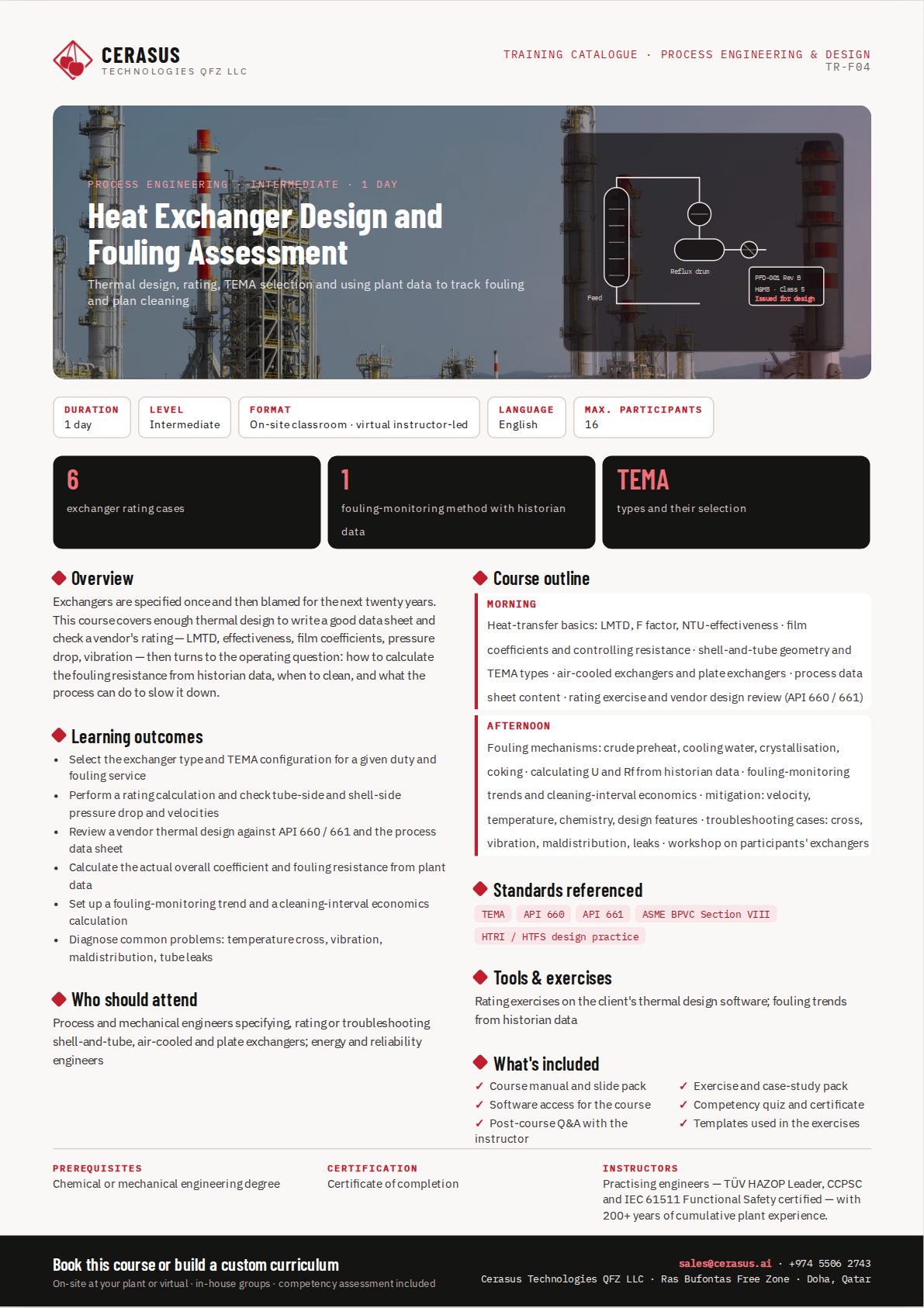
Process and mechanical engineers specifying, rating or troubleshooting shell-and-tube, air-cooled and plate exchangers; energy and reliability engineers
Exchangers are specified once and then blamed for the next twenty years. This course covers enough thermal design to write a good data sheet and check a vendor's rating — LMTD, effectiveness, film coefficients, pressure drop, vibration — then turns to the operating question: how to calculate the fouling resistance from historian data, when to clean, and what the process can do to slow it down.
Heat-transfer basics: LMTD, F factor, NTU-effectiveness · film coefficients and controlling resistance · shell-and-tube geometry and TEMA types · air-cooled exchangers and plate exchangers · process data sheet content · rating exercise and vendor design review (API 660 / 661)
Fouling mechanisms: crude preheat, cooling water, crystallisation, coking · calculating U and Rf from historian data · fouling-monitoring trends and cleaning-interval economics · mitigation: velocity, temperature, chemistry, design features · troubleshooting cases: cross, vibration, maldistribution, leaks · workshop on participants' exchangers
TEMAAPI 660API 661ASME BPVC Section VIIIHTRI / HTFS design practiceSend a short brief — plant, service of interest and what you need to achieve — and a Cerasus engineer will respond with a proposed scope and next steps.
Prefer email or phone? sales@cerasus.ai · +974 5506 2743