Line sizing, pump and control-valve hydraulics, utility balances and energy targeting for revamps and debottlenecking
The flyer below is the printable A4 version. Use the buttons above to download it or the request form.
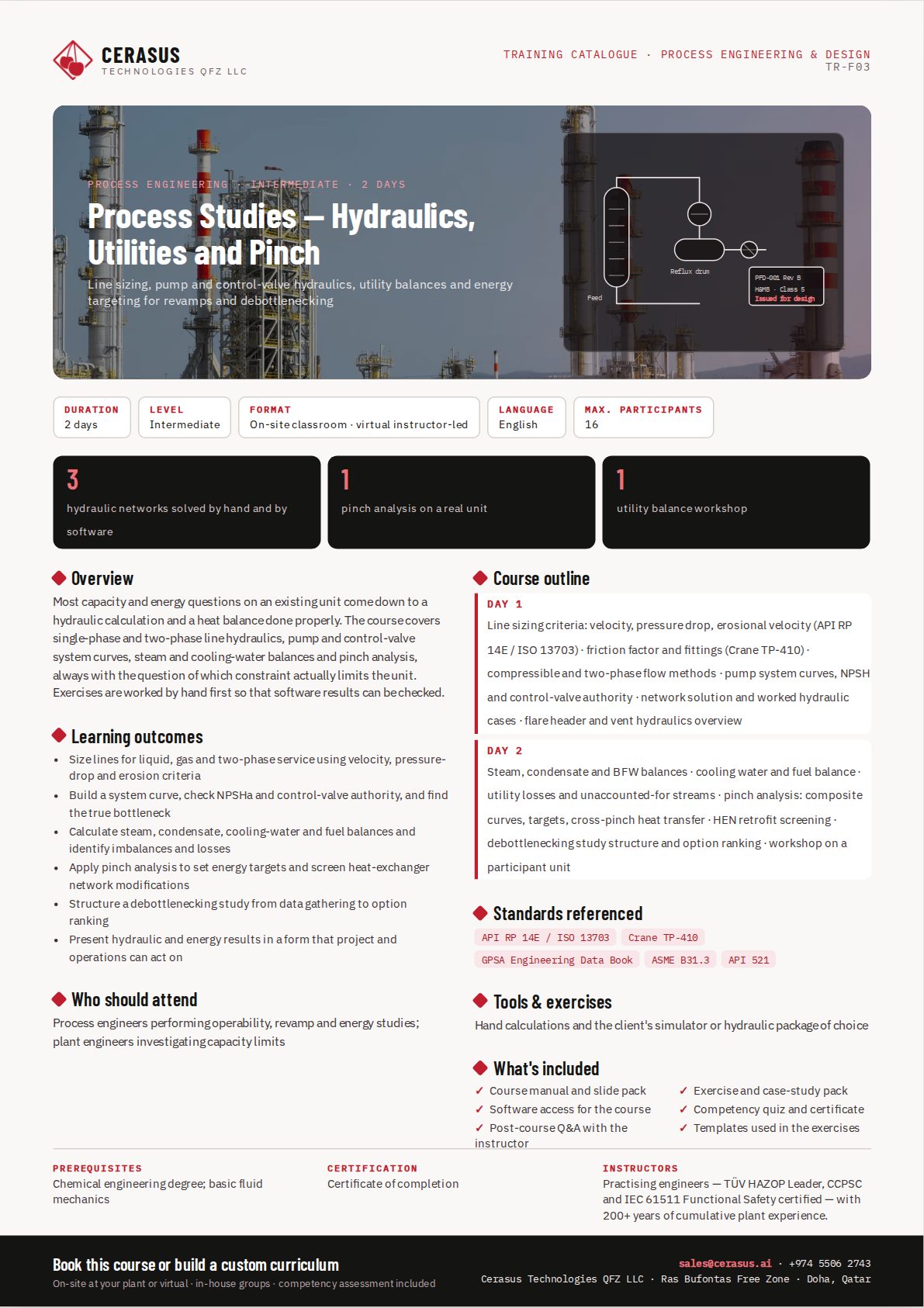
Process engineers performing operability, revamp and energy studies; plant engineers investigating capacity limits
Most capacity and energy questions on an existing unit come down to a hydraulic calculation and a heat balance done properly. The course covers single-phase and two-phase line hydraulics, pump and control-valve system curves, steam and cooling-water balances and pinch analysis, always with the question of which constraint actually limits the unit. Exercises are worked by hand first so that software results can be checked.
Line sizing criteria: velocity, pressure drop, erosional velocity (API RP 14E / ISO 13703) · friction factor and fittings (Crane TP-410) · compressible and two-phase flow methods · pump system curves, NPSH and control-valve authority · network solution and worked hydraulic cases · flare header and vent hydraulics overview
Steam, condensate and BFW balances · cooling water and fuel balance · utility losses and unaccounted-for streams · pinch analysis: composite curves, targets, cross-pinch heat transfer · HEN retrofit screening · debottlenecking study structure and option ranking · workshop on a participant unit
API RP 14E / ISO 13703Crane TP-410GPSA Engineering Data BookASME B31.3API 521Send a short brief — plant, service of interest and what you need to achieve — and a Cerasus engineer will respond with a proposed scope and next steps.
Prefer email or phone? sales@cerasus.ai · +974 5506 2743