What machine learning and agentic AI can and cannot do in a plant, and how to deploy them without losing control
The flyer below is the printable A4 version. Use the buttons above to download it or the request form.
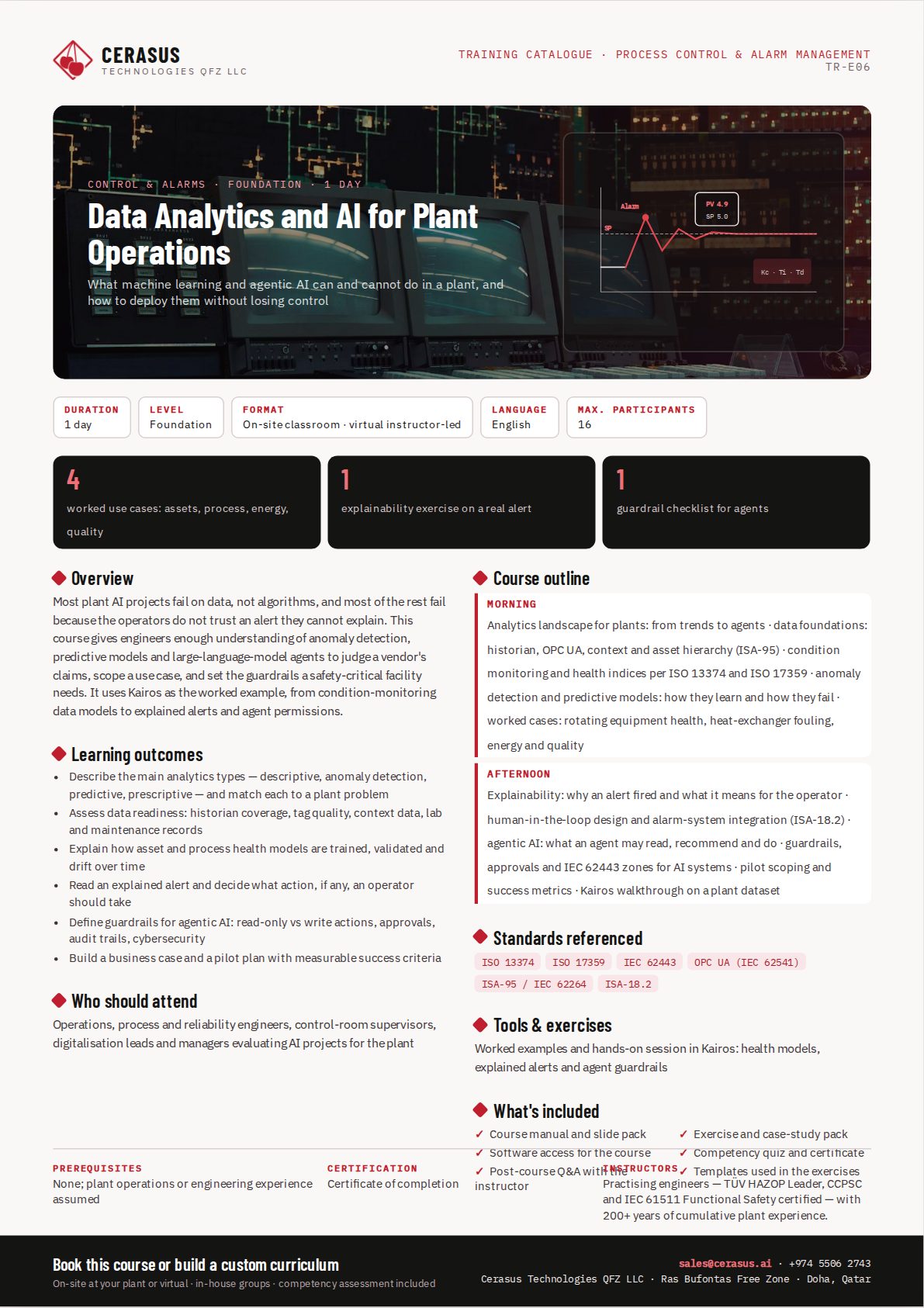
Operations, process and reliability engineers, control-room supervisors, digitalisation leads and managers evaluating AI projects for the plant
Most plant AI projects fail on data, not algorithms, and most of the rest fail because the operators do not trust an alert they cannot explain. This course gives engineers enough understanding of anomaly detection, predictive models and large-language-model agents to judge a vendor's claims, scope a use case, and set the guardrails a safety-critical facility needs. It uses Kairos as the worked example, from condition-monitoring data models to explained alerts and agent permissions.
Analytics landscape for plants: from trends to agents · data foundations: historian, OPC UA, context and asset hierarchy (ISA-95) · condition monitoring and health indices per ISO 13374 and ISO 17359 · anomaly detection and predictive models: how they learn and how they fail · worked cases: rotating equipment health, heat-exchanger fouling, energy and quality
Explainability: why an alert fired and what it means for the operator · human-in-the-loop design and alarm-system integration (ISA-18.2) · agentic AI: what an agent may read, recommend and do · guardrails, approvals and IEC 62443 zones for AI systems · pilot scoping and success metrics · Kairos walkthrough on a plant dataset
ISO 13374ISO 17359IEC 62443OPC UA (IEC 62541)ISA-95 / IEC 62264ISA-18.2Send a short brief — plant, service of interest and what you need to achieve — and a Cerasus engineer will respond with a proposed scope and next steps.
Prefer email or phone? sales@cerasus.ai · +974 5506 2743