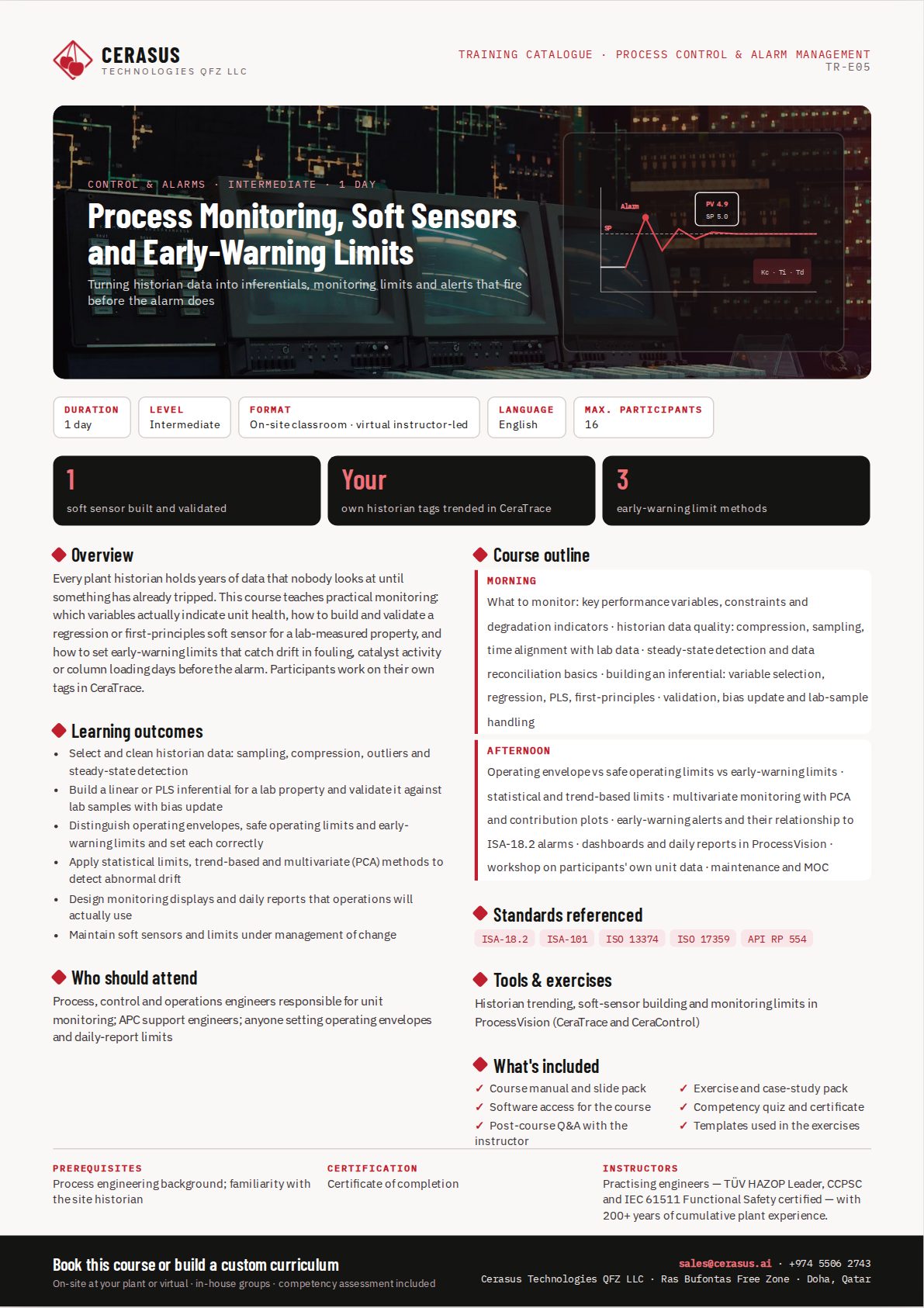
Turning historian data into inferentials, monitoring limits and alerts that fire before the alarm does
The flyer below is the printable A4 version. Use the buttons above to download it or the request form.
Process, control and operations engineers responsible for unit monitoring; APC support engineers; anyone setting operating envelopes and daily-report limits
Every plant historian holds years of data that nobody looks at until something has already tripped. This course teaches practical monitoring: which variables actually indicate unit health, how to build and validate a regression or first-principles soft sensor for a lab-measured property, and how to set early-warning limits that catch drift in fouling, catalyst activity or column loading days before the alarm. Participants work on their own tags in CeraTrace.
What to monitor: key performance variables, constraints and degradation indicators · historian data quality: compression, sampling, time alignment with lab data · steady-state detection and data reconciliation basics · building an inferential: variable selection, regression, PLS, first-principles · validation, bias update and lab-sample handling
Operating envelope vs safe operating limits vs early-warning limits · statistical and trend-based limits · multivariate monitoring with PCA and contribution plots · early-warning alerts and their relationship to ISA-18.2 alarms · dashboards and daily reports in ProcessVision · workshop on participants' own unit data · maintenance and MOC
ISA-18.2ISA-101ISO 13374ISO 17359API RP 554Send a short brief — plant, service of interest and what you need to achieve — and a Cerasus engineer will respond with a proposed scope and next steps.
Prefer email or phone? sales@cerasus.ai · +974 5506 2743