Model-based tuning, loop assessment and the reasons most loops on a unit are still in manual
The flyer below is the printable A4 version. Use the buttons above to download it or the request form.
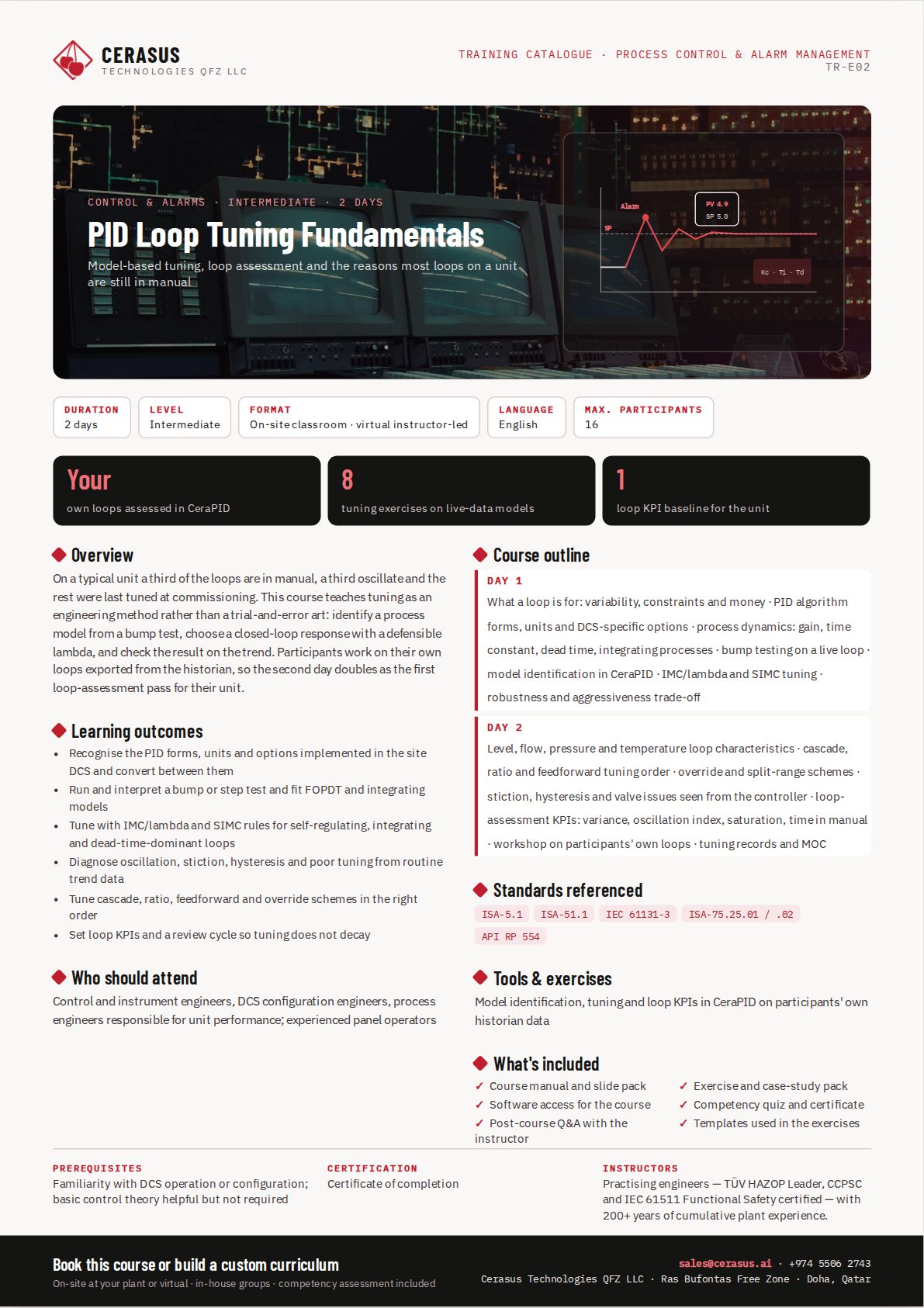
Control and instrument engineers, DCS configuration engineers, process engineers responsible for unit performance; experienced panel operators
On a typical unit a third of the loops are in manual, a third oscillate and the rest were last tuned at commissioning. This course teaches tuning as an engineering method rather than a trial-and-error art: identify a process model from a bump test, choose a closed-loop response with a defensible lambda, and check the result on the trend. Participants work on their own loops exported from the historian, so the second day doubles as the first loop-assessment pass for their unit.
What a loop is for: variability, constraints and money · PID algorithm forms, units and DCS-specific options · process dynamics: gain, time constant, dead time, integrating processes · bump testing on a live loop · model identification in CeraPID · IMC/lambda and SIMC tuning · robustness and aggressiveness trade-off
Level, flow, pressure and temperature loop characteristics · cascade, ratio and feedforward tuning order · override and split-range schemes · stiction, hysteresis and valve issues seen from the controller · loop-assessment KPIs: variance, oscillation index, saturation, time in manual · workshop on participants' own loops · tuning records and MOC
ISA-5.1ISA-51.1IEC 61131-3ISA-75.25.01 / .02API RP 554Send a short brief — plant, service of interest and what you need to achieve — and a Cerasus engineer will respond with a proposed scope and next steps.
Prefer email or phone? sales@cerasus.ai · +974 5506 2743