Building a response plan on credible scenarios and testing it with drills that find weaknesses
The flyer below is the printable A4 version. Use the buttons above to download it or the request form.
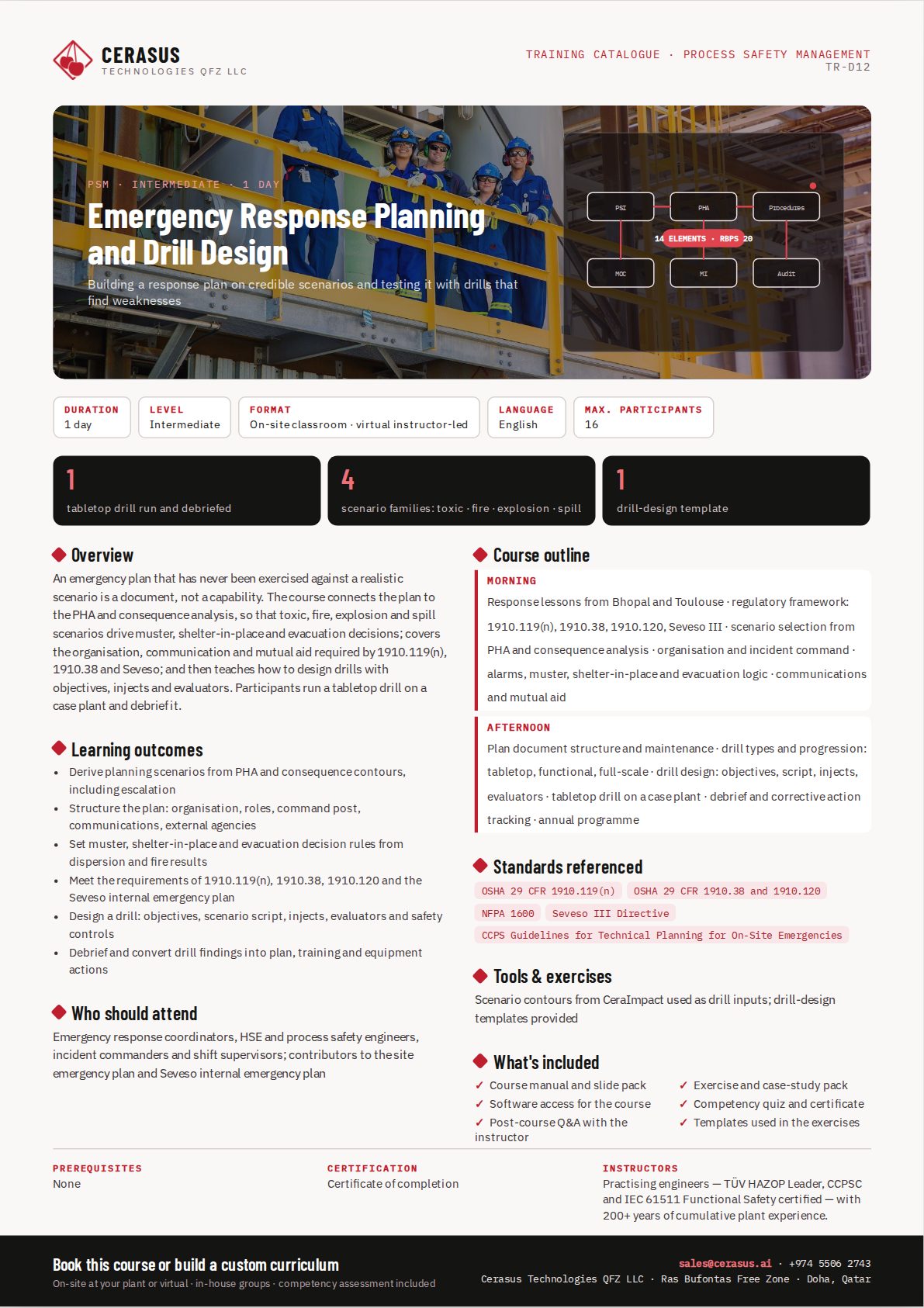
Emergency response coordinators, HSE and process safety engineers, incident commanders and shift supervisors; contributors to the site emergency plan and Seveso internal emergency plan
An emergency plan that has never been exercised against a realistic scenario is a document, not a capability. The course connects the plan to the PHA and consequence analysis, so that toxic, fire, explosion and spill scenarios drive muster, shelter-in-place and evacuation decisions; covers the organisation, communication and mutual aid required by 1910.119(n), 1910.38 and Seveso; and then teaches how to design drills with objectives, injects and evaluators. Participants run a tabletop drill on a case plant and debrief it.
Response lessons from Bhopal and Toulouse · regulatory framework: 1910.119(n), 1910.38, 1910.120, Seveso III · scenario selection from PHA and consequence analysis · organisation and incident command · alarms, muster, shelter-in-place and evacuation logic · communications and mutual aid
Plan document structure and maintenance · drill types and progression: tabletop, functional, full-scale · drill design: objectives, script, injects, evaluators · tabletop drill on a case plant · debrief and corrective action tracking · annual programme
OSHA 29 CFR 1910.119(n)OSHA 29 CFR 1910.38 and 1910.120NFPA 1600Seveso III DirectiveCCPS Guidelines for Technical Planning for On-Site EmergenciesSend a short brief — plant, service of interest and what you need to achieve — and a Cerasus engineer will respond with a proposed scope and next steps.
Prefer email or phone? sales@cerasus.ai · +974 5506 2743