Building an MI programme around the equipment that keeps hazards contained
The flyer below is the printable A4 version. Use the buttons above to download it or the request form.
Inspection, maintenance and reliability engineers; PSM coordinators owning the MI element; operations engineers responsible for safeguards on their unit
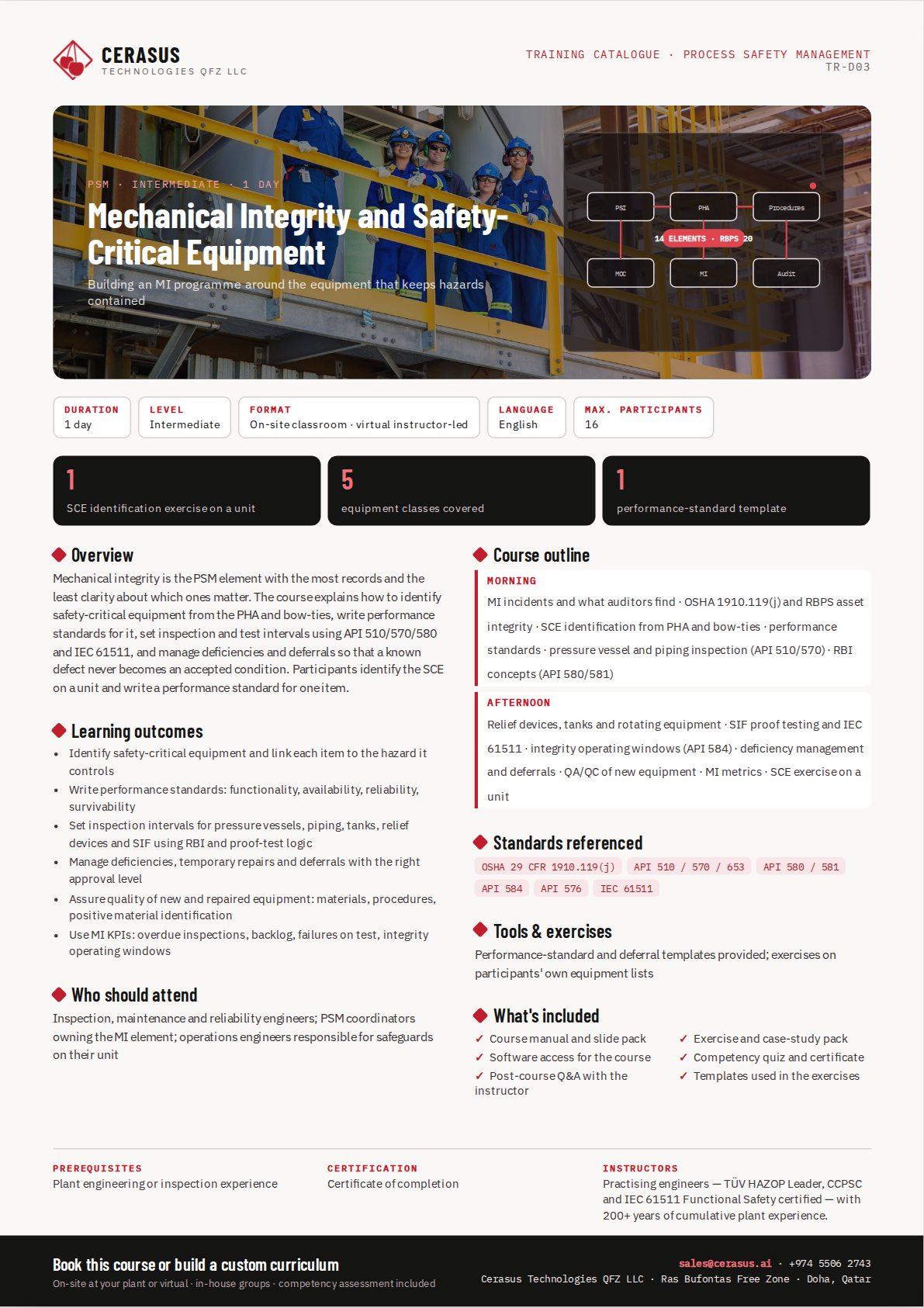
Mechanical integrity is the PSM element with the most records and the least clarity about which ones matter. The course explains how to identify safety-critical equipment from the PHA and bow-ties, write performance standards for it, set inspection and test intervals using API 510/570/580 and IEC 61511, and manage deficiencies and deferrals so that a known defect never becomes an accepted condition. Participants identify the SCE on a unit and write a performance standard for one item.
MI incidents and what auditors find · OSHA 1910.119(j) and RBPS asset integrity · SCE identification from PHA and bow-ties · performance standards · pressure vessel and piping inspection (API 510/570) · RBI concepts (API 580/581)
Relief devices, tanks and rotating equipment · SIF proof testing and IEC 61511 · integrity operating windows (API 584) · deficiency management and deferrals · QA/QC of new equipment · MI metrics · SCE exercise on a unit
OSHA 29 CFR 1910.119(j)API 510 / 570 / 653API 580 / 581API 584API 576IEC 61511Send a short brief — plant, service of interest and what you need to achieve — and a Cerasus engineer will respond with a proposed scope and next steps.
Prefer email or phone? sales@cerasus.ai · +974 5506 2743