Checking existing relief devices against current process conditions and building a register that holds up
The flyer below is the printable A4 version. Use the buttons above to download it or the request form.
Process and pressure-equipment engineers responsible for the relief register; inspection engineers; PSM coordinators covering PSI and mechanical integrity
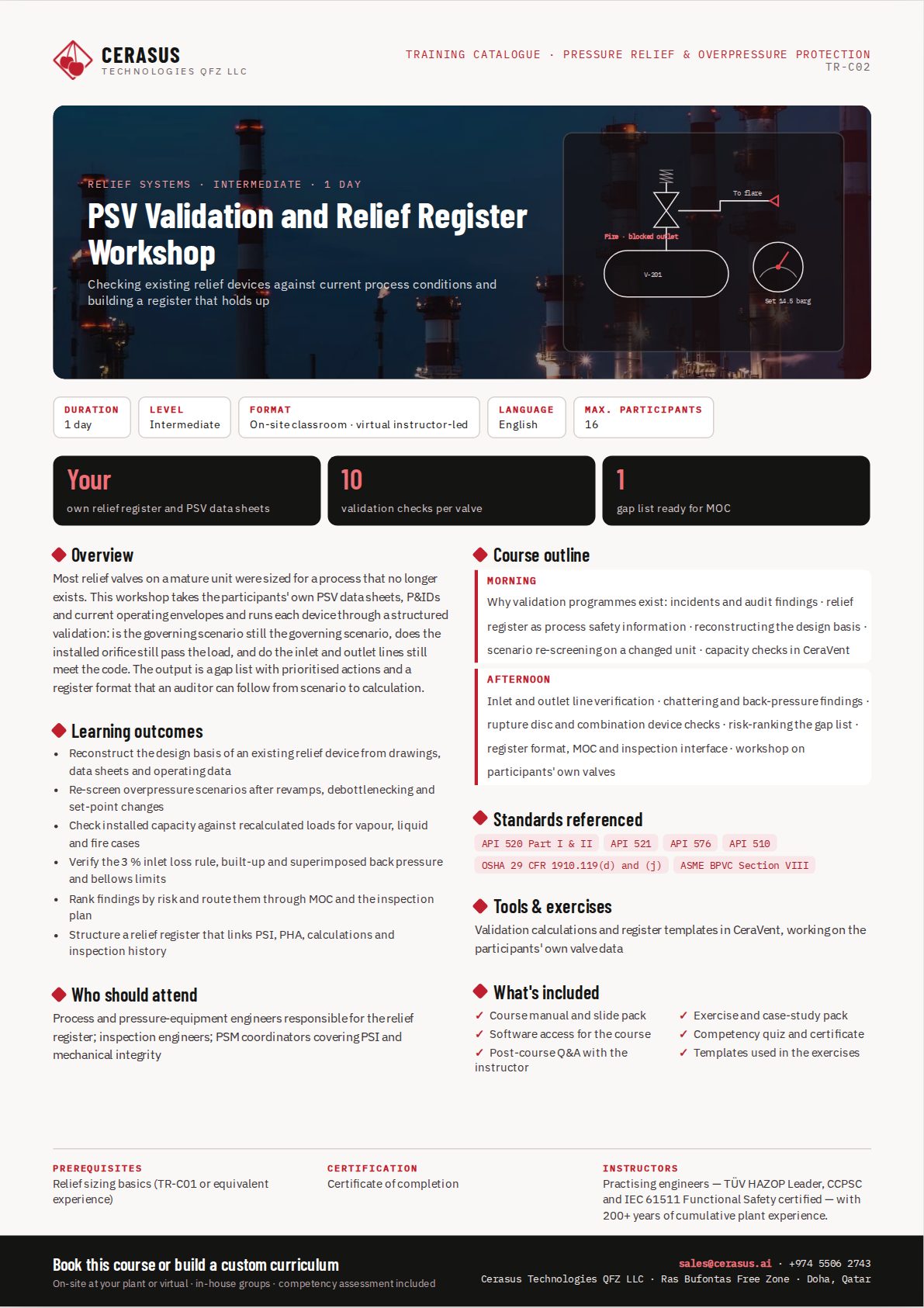
Most relief valves on a mature unit were sized for a process that no longer exists. This workshop takes the participants' own PSV data sheets, P&IDs and current operating envelopes and runs each device through a structured validation: is the governing scenario still the governing scenario, does the installed orifice still pass the load, and do the inlet and outlet lines still meet the code. The output is a gap list with prioritised actions and a register format that an auditor can follow from scenario to calculation.
Why validation programmes exist: incidents and audit findings · relief register as process safety information · reconstructing the design basis · scenario re-screening on a changed unit · capacity checks in CeraVent
Inlet and outlet line verification · chattering and back-pressure findings · rupture disc and combination device checks · risk-ranking the gap list · register format, MOC and inspection interface · workshop on participants' own valves
API 520 Part I & IIAPI 521API 576API 510OSHA 29 CFR 1910.119(d) and (j)ASME BPVC Section VIIISend a short brief — plant, service of interest and what you need to achieve — and a Cerasus engineer will respond with a proposed scope and next steps.
Prefer email or phone? sales@cerasus.ai · +974 5506 2743