Overpressure scenarios, sizing and documentation to API 520 / 521 / 526
The flyer below is the printable A4 version. Use the buttons above to download it or the request form.
Process engineers responsible for relief design, validation and the relief register; inspection engineers
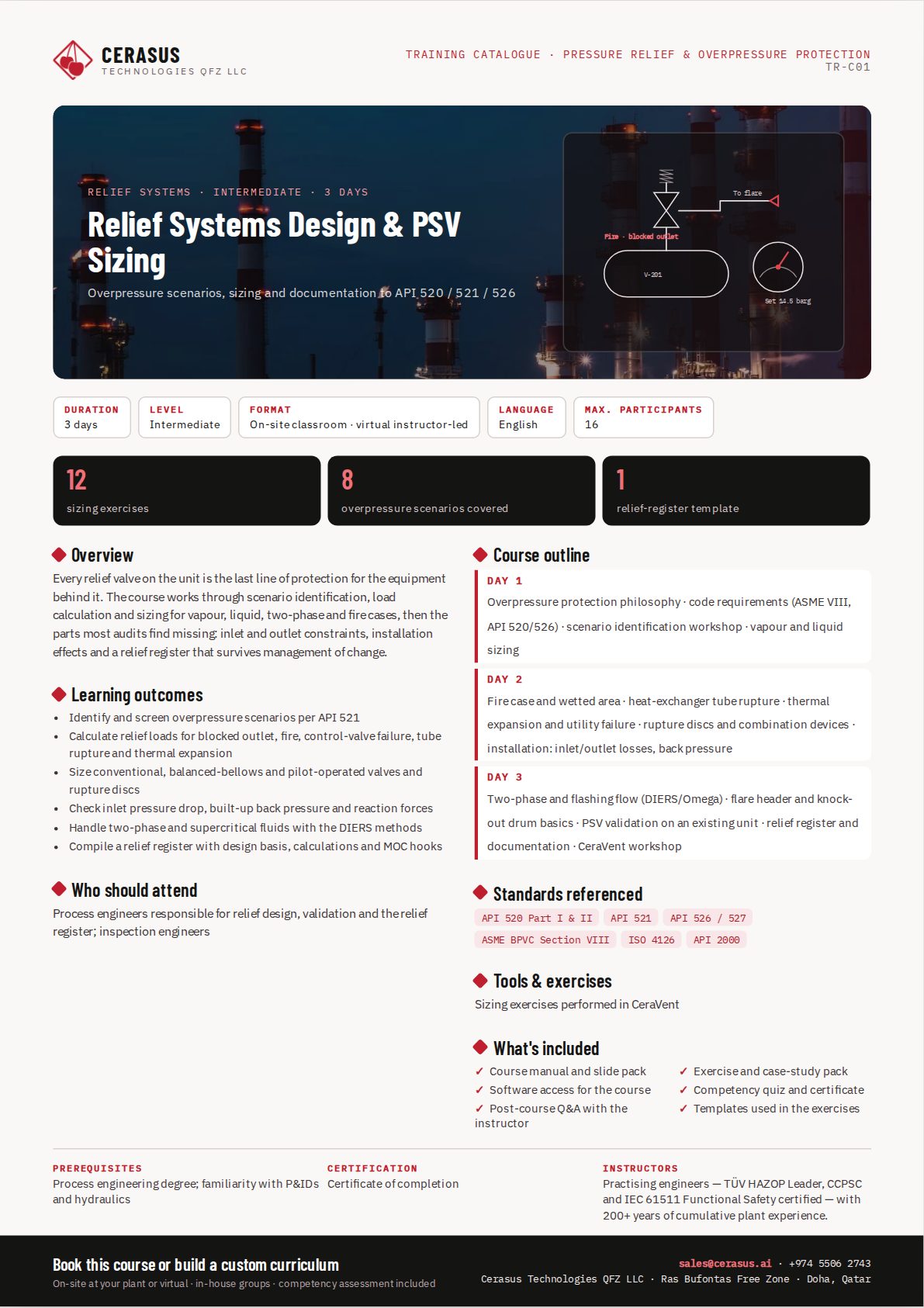
Every relief valve on the unit is the last line of protection for the equipment behind it. The course works through scenario identification, load calculation and sizing for vapour, liquid, two-phase and fire cases, then the parts most audits find missing: inlet and outlet constraints, installation effects and a relief register that survives management of change.
Overpressure protection philosophy · code requirements (ASME VIII, API 520/526) · scenario identification workshop · vapour and liquid sizing
Fire case and wetted area · heat-exchanger tube rupture · thermal expansion and utility failure · rupture discs and combination devices · installation: inlet/outlet losses, back pressure
Two-phase and flashing flow (DIERS/Omega) · flare header and knock-out drum basics · PSV validation on an existing unit · relief register and documentation · CeraVent workshop
API 520 Part I & IIAPI 521API 526 / 527ASME BPVC Section VIIIISO 4126API 2000Send a short brief — plant, service of interest and what you need to achieve — and a Cerasus engineer will respond with a proposed scope and next steps.
Prefer email or phone? sales@cerasus.ai · +974 5506 2743