Recognising, assessing and controlling the hazards that HAZOP guidewords miss
The flyer below is the printable A4 version. Use the buttons above to download it or the request form.
Process, safety and operations engineers on sites handling powders, polymers, catalysts, monomers, peroxides or other reactive materials; PHA leaders
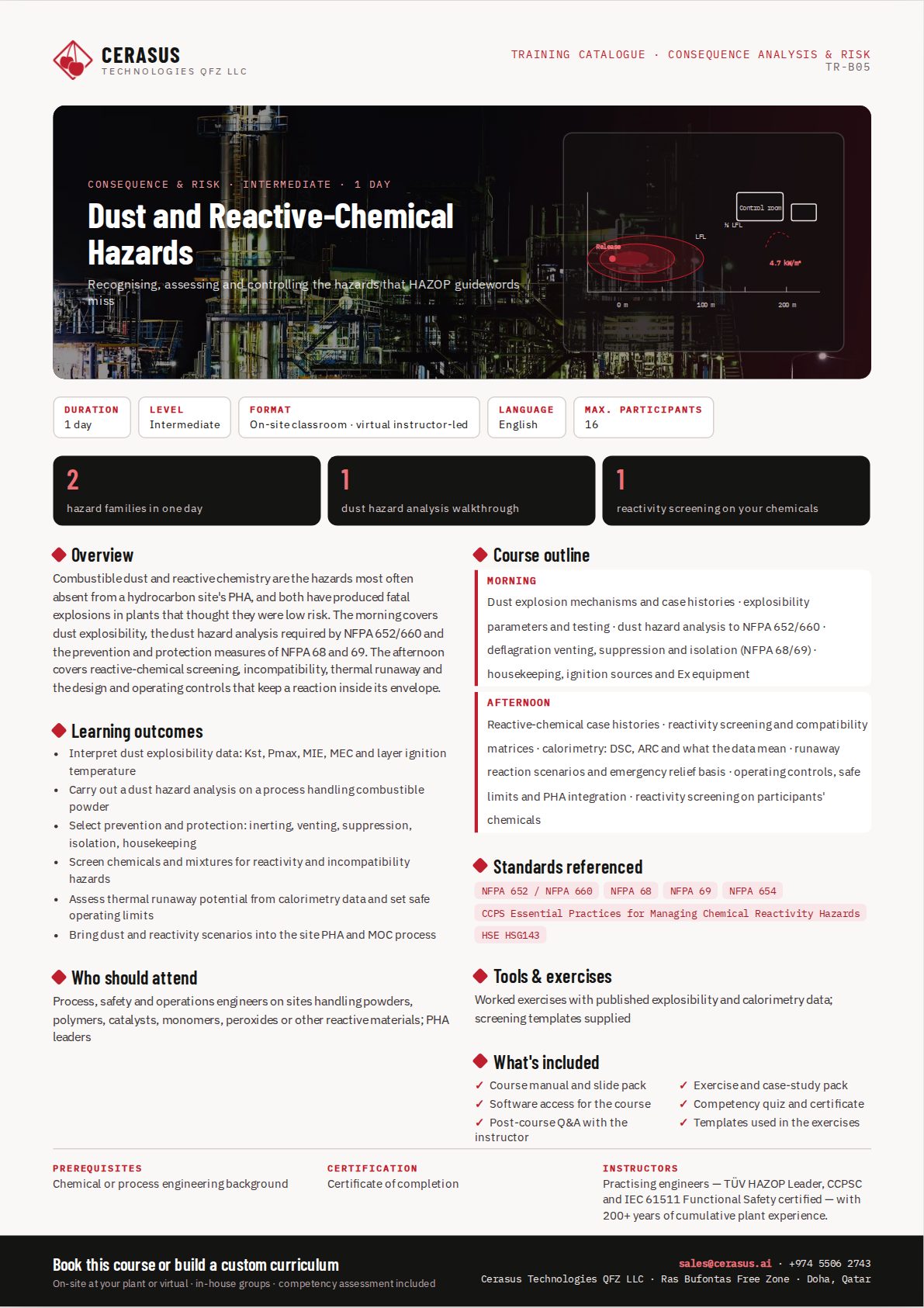
Combustible dust and reactive chemistry are the hazards most often absent from a hydrocarbon site's PHA, and both have produced fatal explosions in plants that thought they were low risk. The morning covers dust explosibility, the dust hazard analysis required by NFPA 652/660 and the prevention and protection measures of NFPA 68 and 69. The afternoon covers reactive-chemical screening, incompatibility, thermal runaway and the design and operating controls that keep a reaction inside its envelope.
Dust explosion mechanisms and case histories · explosibility parameters and testing · dust hazard analysis to NFPA 652/660 · deflagration venting, suppression and isolation (NFPA 68/69) · housekeeping, ignition sources and Ex equipment
Reactive-chemical case histories · reactivity screening and compatibility matrices · calorimetry: DSC, ARC and what the data mean · runaway reaction scenarios and emergency relief basis · operating controls, safe limits and PHA integration · reactivity screening on participants' chemicals
NFPA 652 / NFPA 660NFPA 68NFPA 69NFPA 654CCPS Essential Practices for Managing Chemical Reactivity HazardsHSE HSG143Send a short brief — plant, service of interest and what you need to achieve — and a Cerasus engineer will respond with a proposed scope and next steps.
Prefer email or phone? sales@cerasus.ai · +974 5506 2743