Building, interpreting and defending a QRA for land-use planning, safety cases and design decisions
The flyer below is the printable A4 version. Use the buttons above to download it or the request form.
Process safety and loss-prevention engineers, safety-case and Seveso report authors, project engineers reviewing QRA deliverables from consultants
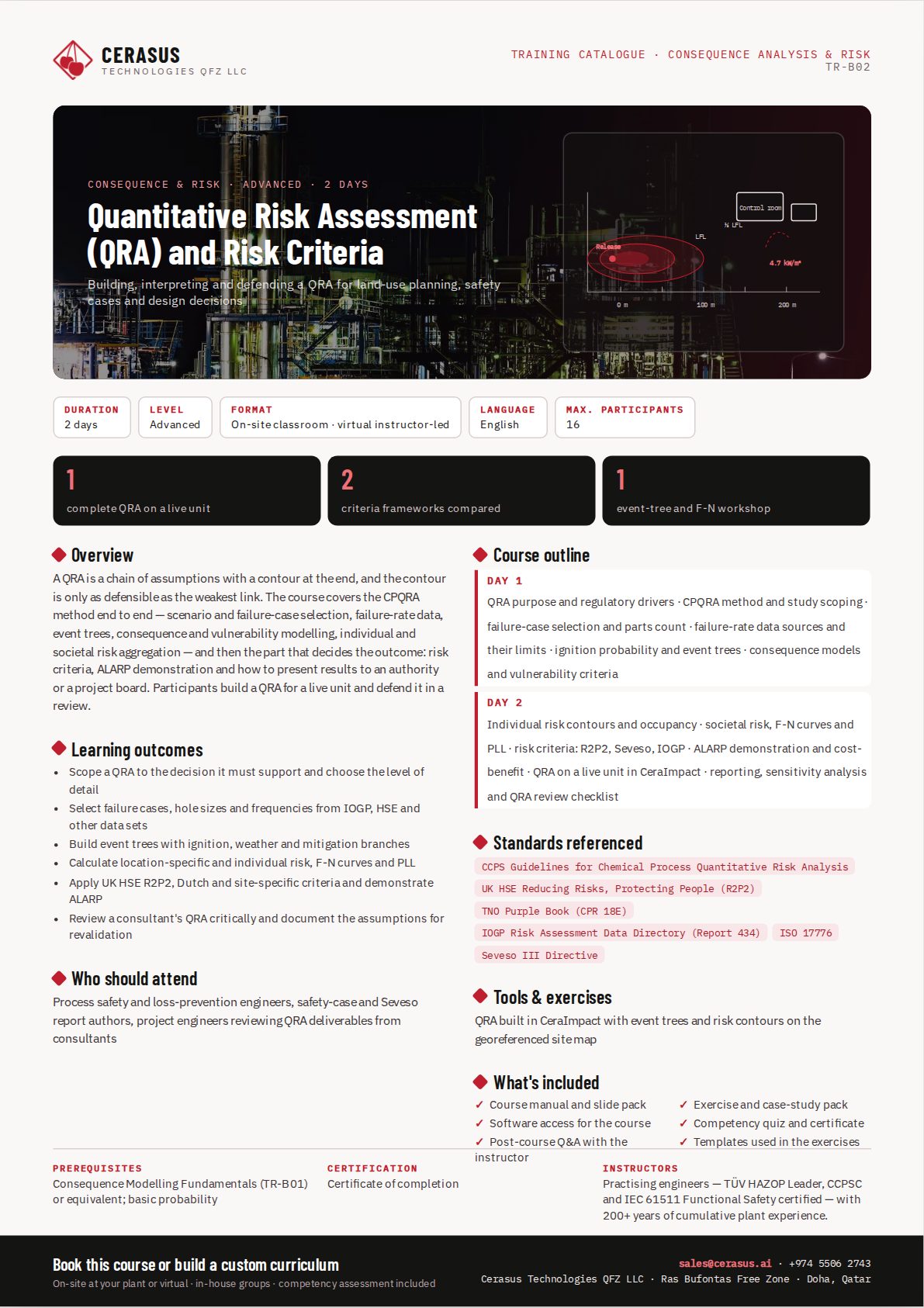
A QRA is a chain of assumptions with a contour at the end, and the contour is only as defensible as the weakest link. The course covers the CPQRA method end to end — scenario and failure-case selection, failure-rate data, event trees, consequence and vulnerability modelling, individual and societal risk aggregation — and then the part that decides the outcome: risk criteria, ALARP demonstration and how to present results to an authority or a project board. Participants build a QRA for a live unit and defend it in a review.
QRA purpose and regulatory drivers · CPQRA method and study scoping · failure-case selection and parts count · failure-rate data sources and their limits · ignition probability and event trees · consequence models and vulnerability criteria
Individual risk contours and occupancy · societal risk, F-N curves and PLL · risk criteria: R2P2, Seveso, IOGP · ALARP demonstration and cost-benefit · QRA on a live unit in CeraImpact · reporting, sensitivity analysis and QRA review checklist
CCPS Guidelines for Chemical Process Quantitative Risk AnalysisUK HSE Reducing Risks, Protecting People (R2P2)TNO Purple Book (CPR 18E)IOGP Risk Assessment Data Directory (Report 434)ISO 17776Seveso III DirectiveSend a short brief — plant, service of interest and what you need to achieve — and a Cerasus engineer will respond with a proposed scope and next steps.
Prefer email or phone? sales@cerasus.ai · +974 5506 2743