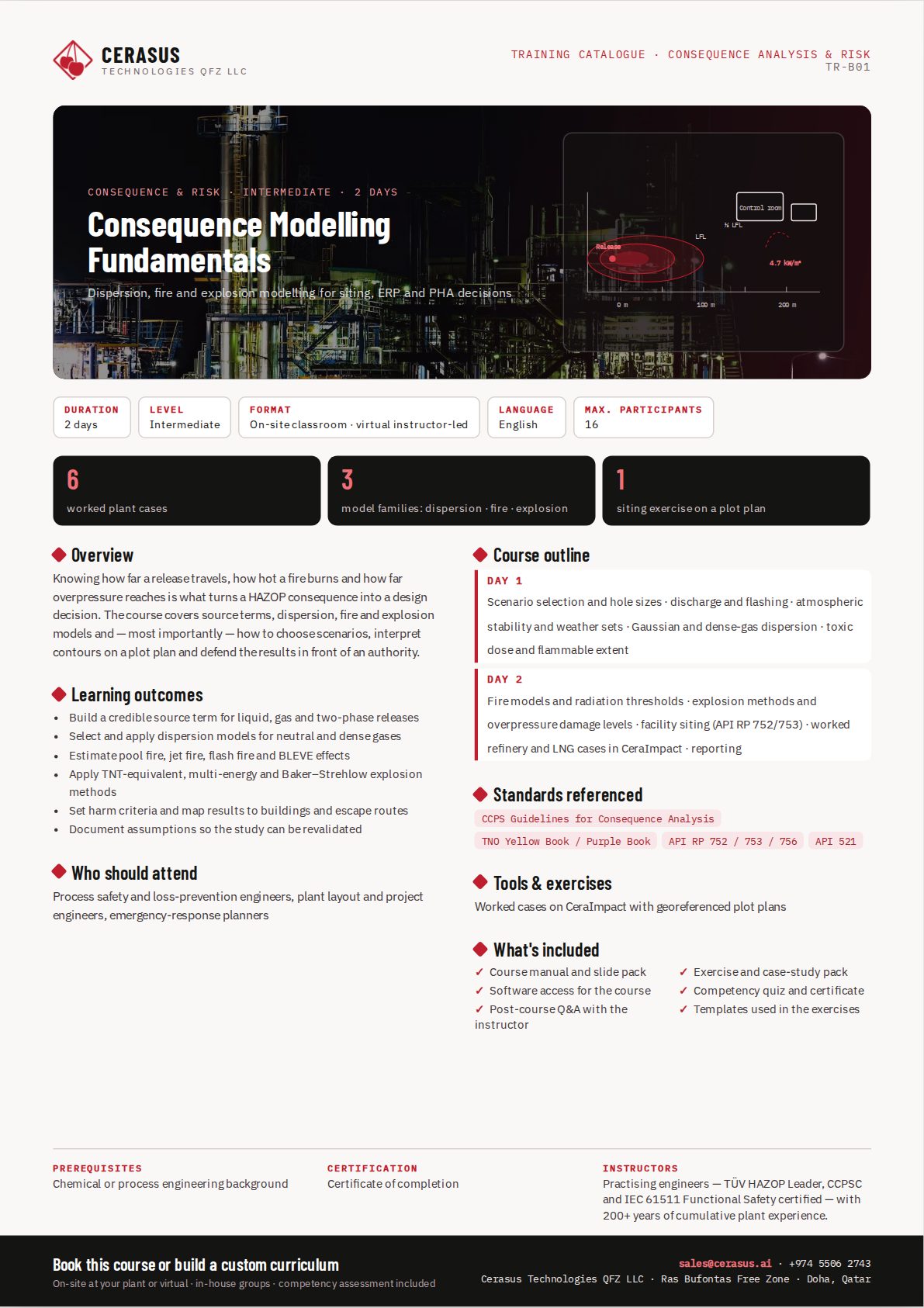
Dispersion, fire and explosion modelling for siting, ERP and PHA decisions
The flyer below is the printable A4 version. Use the buttons above to download it or the request form.
Process safety and loss-prevention engineers, plant layout and project engineers, emergency-response planners
Knowing how far a release travels, how hot a fire burns and how far overpressure reaches is what turns a HAZOP consequence into a design decision. The course covers source terms, dispersion, fire and explosion models and — most importantly — how to choose scenarios, interpret contours on a plot plan and defend the results in front of an authority.
Scenario selection and hole sizes · discharge and flashing · atmospheric stability and weather sets · Gaussian and dense-gas dispersion · toxic dose and flammable extent
Fire models and radiation thresholds · explosion methods and overpressure damage levels · facility siting (API RP 752/753) · worked refinery and LNG cases in CeraImpact · reporting
CCPS Guidelines for Consequence AnalysisTNO Yellow Book / Purple BookAPI RP 752 / 753 / 756API 521Send a short brief — plant, service of interest and what you need to achieve — and a Cerasus engineer will respond with a proposed scope and next steps.
Prefer email or phone? sales@cerasus.ai · +974 5506 2743