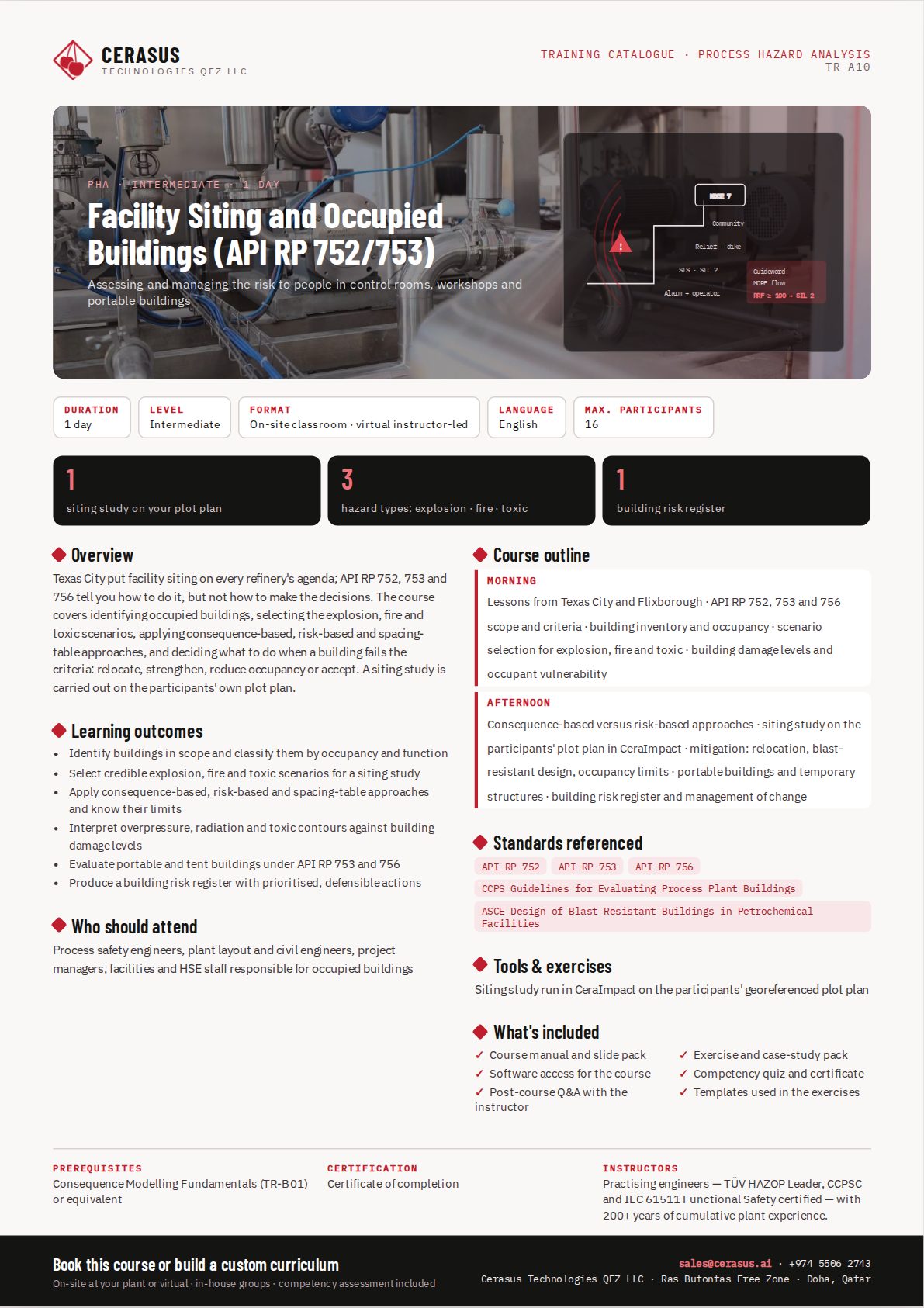
Assessing and managing the risk to people in control rooms, workshops and portable buildings
The flyer below is the printable A4 version. Use the buttons above to download it or the request form.
Process safety engineers, plant layout and civil engineers, project managers, facilities and HSE staff responsible for occupied buildings
Texas City put facility siting on every refinery's agenda; API RP 752, 753 and 756 tell you how to do it, but not how to make the decisions. The course covers identifying occupied buildings, selecting the explosion, fire and toxic scenarios, applying consequence-based, risk-based and spacing-table approaches, and deciding what to do when a building fails the criteria: relocate, strengthen, reduce occupancy or accept. A siting study is carried out on the participants' own plot plan.
Lessons from Texas City and Flixborough · API RP 752, 753 and 756 scope and criteria · building inventory and occupancy · scenario selection for explosion, fire and toxic · building damage levels and occupant vulnerability
Consequence-based versus risk-based approaches · siting study on the participants' plot plan in CeraImpact · mitigation: relocation, blast-resistant design, occupancy limits · portable buildings and temporary structures · building risk register and management of change
API RP 752API RP 753API RP 756CCPS Guidelines for Evaluating Process Plant BuildingsASCE Design of Blast-Resistant Buildings in Petrochemical FacilitiesSend a short brief — plant, service of interest and what you need to achieve — and a Cerasus engineer will respond with a proposed scope and next steps.
Prefer email or phone? sales@cerasus.ai · +974 5506 2743