What the standards require, who owns each phase and where sites fall short
The flyer below is the printable A4 version. Use the buttons above to download it or the request form.
Engineers, supervisors and managers who touch a safety instrumented system without being SIS specialists: process, operations, maintenance, projects, HSE and asset integrity
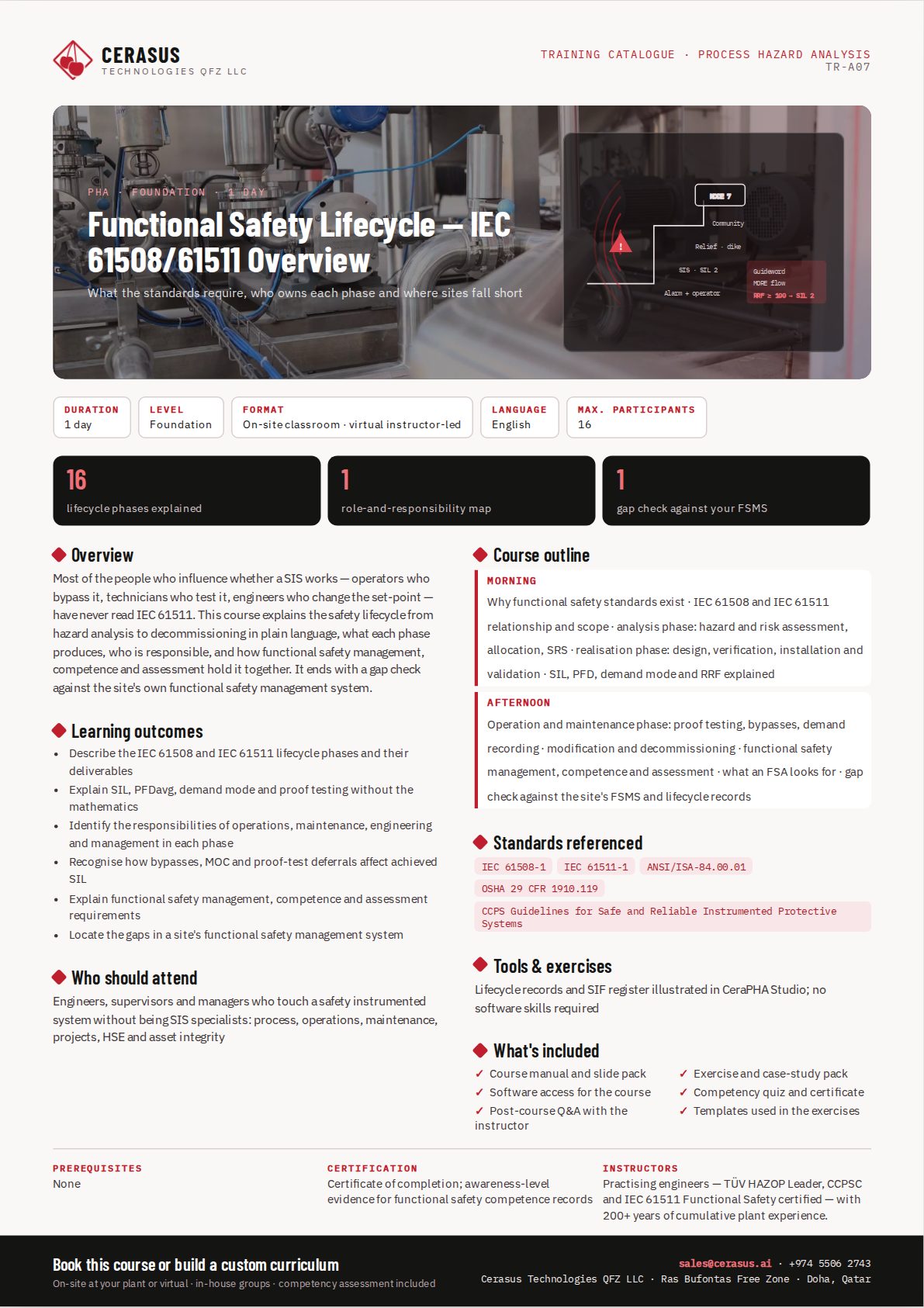
Most of the people who influence whether a SIS works — operators who bypass it, technicians who test it, engineers who change the set-point — have never read IEC 61511. This course explains the safety lifecycle from hazard analysis to decommissioning in plain language, what each phase produces, who is responsible, and how functional safety management, competence and assessment hold it together. It ends with a gap check against the site's own functional safety management system.
Why functional safety standards exist · IEC 61508 and IEC 61511 relationship and scope · analysis phase: hazard and risk assessment, allocation, SRS · realisation phase: design, verification, installation and validation · SIL, PFD, demand mode and RRF explained
Operation and maintenance phase: proof testing, bypasses, demand recording · modification and decommissioning · functional safety management, competence and assessment · what an FSA looks for · gap check against the site's FSMS and lifecycle records
IEC 61508-1IEC 61511-1ANSI/ISA-84.00.01OSHA 29 CFR 1910.119CCPS Guidelines for Safe and Reliable Instrumented Protective SystemsSend a short brief — plant, service of interest and what you need to achieve — and a Cerasus engineer will respond with a proposed scope and next steps.
Prefer email or phone? sales@cerasus.ai · +974 5506 2743