Semi-quantitative risk assessment from HAZOP scenario to SIL target
The flyer below is the printable A4 version. Use the buttons above to download it or the request form.
Process safety, process and instrument engineers who perform or review LOPA; HAZOP leaders; SIS engineers who receive LOPA results
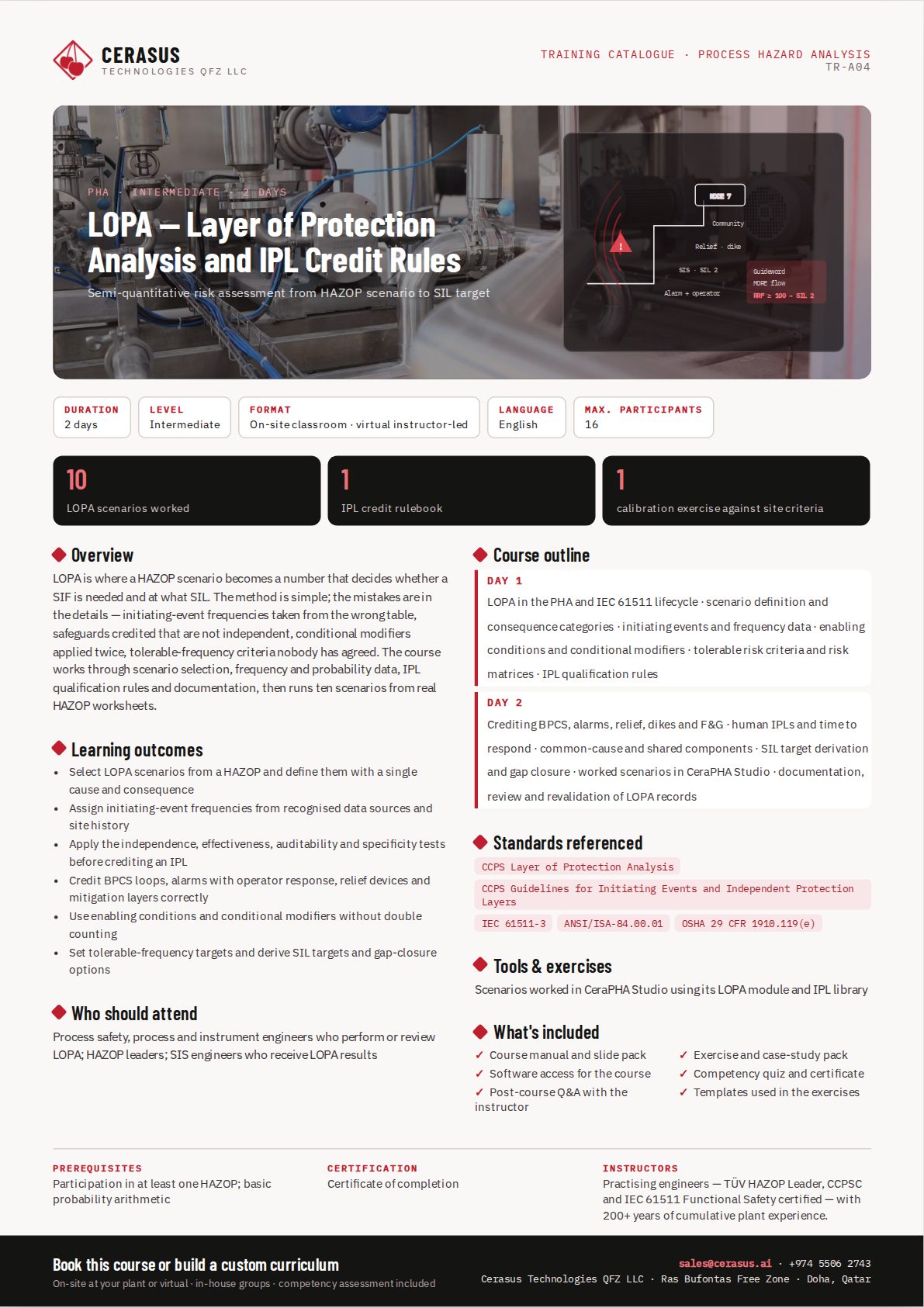
LOPA is where a HAZOP scenario becomes a number that decides whether a SIF is needed and at what SIL. The method is simple; the mistakes are in the details — initiating-event frequencies taken from the wrong table, safeguards credited that are not independent, conditional modifiers applied twice, tolerable-frequency criteria nobody has agreed. The course works through scenario selection, frequency and probability data, IPL qualification rules and documentation, then runs ten scenarios from real HAZOP worksheets.
LOPA in the PHA and IEC 61511 lifecycle · scenario definition and consequence categories · initiating events and frequency data · enabling conditions and conditional modifiers · tolerable risk criteria and risk matrices · IPL qualification rules
Crediting BPCS, alarms, relief, dikes and F&G · human IPLs and time to respond · common-cause and shared components · SIL target derivation and gap closure · worked scenarios in CeraPHA Studio · documentation, review and revalidation of LOPA records
CCPS Layer of Protection AnalysisCCPS Guidelines for Initiating Events and Independent Protection LayersIEC 61511-3ANSI/ISA-84.00.01OSHA 29 CFR 1910.119(e)Send a short brief — plant, service of interest and what you need to achieve — and a Cerasus engineer will respond with a proposed scope and next steps.
Prefer email or phone? sales@cerasus.ai · +974 5506 2743